Economic
We built Economic to answer an economics question. When a swarm has limited compute and time, how do you get agents to spend them on work that advances your goal or makes the rest of the team more effective?
Try it or learn more
About the project
Give ten agents a research job and several may write the same data cleaner before any of them gets to the research. One agent could write it once. Another might know better which data to collect. To make that division of work worthwhile, the agent that builds the cleaner needs a way to get credit for what its teammates can do with it.
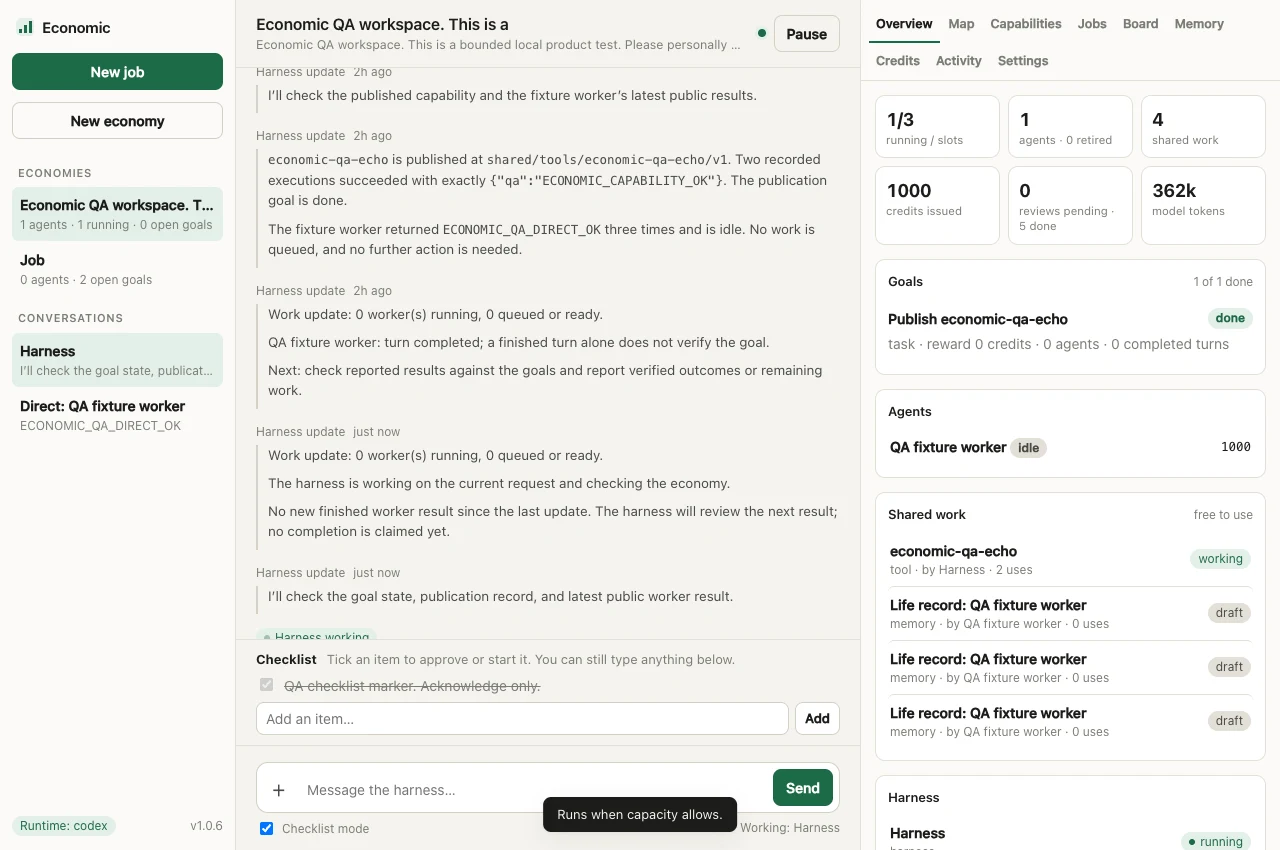
You give Economic’s harness a goal and set the limits. It sets checkpoints and gives agents an initial balance of credits. Active work uses credits. Progress and useful contributions can earn them back. In the current version, agents reuse shared work for free. A reviewer sees what a worker used and the harness credits the original builder when it helped. The ledger records which work earned the reward. The user’s authority still governs real spending.
In a two-agent prototype run, one agent published a CSV-to-Markdown tool and another used it to write a report. The report used the shared tool three times. The reviewer awarded the builder 180 internal credits, and the consumer paid nothing. That run showed the reward loop working. The question I want to measure next is whether the same budget buys more useful work when the swarm uses those incentives.
Economic runs on Apple silicon Macs with Codex CLI or Claude Code.
Related writing
Why we built an economy for agents
A swarm has a limited budget. What would make an agent spend some of it building a tool everyone else can use?
Should an agent get paid every time I call its tool?
Why Economic makes reuse free, and what a successful tool call leaves out of the credit decision.
From the same collection
Project history (5)
- Published the design for sharing work
I wrote up how a team gets goals, how agents share tools, and how the system awards credits. I also outlined a managed service and a self-hosted harness.
Economic's design notes at economic.run/economy. - Made the plugin available to install
The public Codex install guide shipped with an Apple-notarized Mac app and installer. The setup preserved existing economy settings.
Economic install guide and October 6 notarization checks. - Saved agent replies and reports
Codex replies stayed with the conversation that started the job. Agents could save charts, tables, and diagrams in the same workspace.
October 6 conversation and report tests. - Released Mac app 0.9.32
The Mac app and installer passed Apple's notarization and Gatekeeper checks.
Economic 0.9.32 release record. - Released Economic 1.0.6 for Mac
The release included the Mac workspace and matching command-line tools.
Economic 1.0.6 release and install guide at economic.run/install.